
Visions of Glory
The Making of Mirage Jr.
This content was originally included in an issue of Duelist magazine. The original article can be accessed via Internet Archive here.
Main Magazine Page: The Duelist #15
By Michael G. Ryan
Jamuraa has undergone quite a few changes since the events of Mirage: War is everywhere. The three nations of the continent—Femeref, Zhalfir, and Suq’Ata—have practically crumbled under the repeated assaults of the would-be conqueror Kaervek. Mangara remains captured in the amber prison; Teferi remains aloof from the destruction raining down upon Jamuraa; and Jolrael remains confused bv her allegiance to the evil, manipulative Kaervek. For others, strange visionary dreams of the future have begun. And for one, these visions are of death.
Welcome to the last leg of your travels across Jamuraa—Visions, Wizards of the Coast’s tenth expansion for Magic: The Gathering, returns players to the setting of last year’s stand-alone expansion Mirage, where lions sleep in the afternoon sun while efreets pass overhead, disappearing and reappearing in turn. With over 160 new cards, Visions builds on phasing and flanking, adds over a dozen flyers to the play environment, and revitalizes the concept of returning cards to the hand. Add to this the chance to play some enchantments as instants, and the playing field will change so rapidly that players might want to get their vision checked.
Visions Fission
Visions and Mirage have a great deal in common, beginning with the design team. Bill Rose, Joel Mick, Charlie Catino, Don Felice, and Howard Kahlenberg designed the sets simultaneously, dove-tailing concepts, costs, and strategies to make the Type II environment in particular a lively battleground for players. And because the two expansions are essentially one set divided, players will find a wide variety of concepts working fairly effectively together— Shallow rave from Mirage, for example, brings a creature from the graveyard to play unaffected by summoning sickness, but the creature has to be buried at the end of any turn. Vanishing, a blue enchant creature card from Visions, lets a player pay UU to phase out the enchanted creature. The two cards together, co-developer Mark Rosewater points out, can turn Shallow Grave into an Animate Dead variant.
“Players who really, really liked Mirage and wished that set had been bigger,” says co-designer Bill Rose, “are going to be ‘very pleased with Visions.”
Additionally, Visions continues the story begun in Mirage, following the war amongst the mages to its tragic conclusion. And even as players reacquaint themselves with Shauku, Hakim, or Rashida Scalebane, they’ll encounter other names that are blasts blasts from the past—atogs rear their toothy heads again, a tutor returns to educate players of black, the mysterious Elkin provides a peek into its lair, and an ancient king named Suleiman passes his legacy down to plague the djinns and efreets of Jamuraa.
We’ve also added a couple of powerful minotaurs, says Rose. “So players will finally be able to use their Didgeridoos.”
Revision and Re-Vision
The more things change, the more things…well, change. Though it began life as Mirage Jr., Visions quickly went through a series of name changes: early names included Lion’s Eye (to tie in with the Lion’s Eye Diamond from Mirage) and Jungle’s Edge (to complement the African feel of the set). Initially, Visions itself was discarded as a possibility because it was a card name in both Legends and Fourth Edition; this same argument led to the card Mirage being renamed Shimmer in Mirage, but Asmira’s prophecies were central enough to the backstory to make the name work. Other names (see sidebar on page 64) were not so appropriate.
“We had to change Sheitan to Nekrataal,” Rose points out. “Sheitan means ‘Satan* to Muslims, and it has never been our intent to offend anyone.”
Some names were changed to accommodate story (the goblin keepers named their prize djinn—originally called Magglethorpe—”Cook Us,” or Kookus), to appease team members (I personally rallied tor the former “Whirlpool” Djnn to be named Waterspout Djinn), or to fit the card (Kyscu Drake is, of course, “Sucky” Drake, though Rose conceded that the 2/2 flyer is actually “better than it should be for green”).
Card powers changed along the way as well. For example, Fireblast, a red instant for 5R, allows its caster to sacrifice two mountains instead of paying its cost, and then to deal 4 damage to a creature or player. But the card, according to Rose was originally broken. Instead of sacrificing, Fireblast’s caster returned three mountains to his or her hand. This allowed a player to gain an exceptional advance when playing with Armageddon.
Other cards simply didn’t make the cut:
- “Super-Phase,” a blue instant for 3UUU, phased out a player’s library; hand, and graveyard, as well as all of that player’s permanents, and reduced all damage dealt to that player to 0 until the beginning of that players next upkeep.
- “Recurring Nightmare” was a black enchant creature card that, when played on a creature its caster controlled, gave that creature + 1/+1 and phasing. Additionally, if that creature were ever put into the graveyard, it was removed from the game—and another creature was taken from the graveyard, put into play, and enchanted with Recurring Nightmare.
- “Commandant Titmoore” (which became Gypt the Gnarled) was a red legend that counted as a goblin and made all of its controller’s creatures 2/2. “This card could become confusing when another card like Gypt comes into play” Rose says. “What if I play another card that says all creatures become 3/3? Which card do I process first?”
Rose notes that while Gypt’s abilities might be sidelined, Gypt himself may yet show up in a future expansion, along with such cut cards as “Demented Goblin Sorcerer.” Rothello (a green legend), and “Goblin Life Machine.”
Becoming a Deckrosavant
Visions offers players a wide variety of new and potentially powerful cards, many of which will require a little practice to perfect. Cards like the black sorcery Forbidden Ritual (“Sacrifice a card in play: Target opponnent loses 2 life unless he or she sacrifices a permanent or chooses and discards a card. You may repeat this process as many times as you choose”) will force players to carefully consider precisely how the playing field shifts with each decision. But even this challenging card promises to be child’s play compared to Rose’s choice for the most interesting.
“Chronatog,” he says with certainty, citing one of his favorite cards. A 1/2 creature that gets +3/+3 until end of turn for the cost of skipping your next turn, the Chronatog will undoubtedly become popular, Rose predicts. “In a Stasis-Kismet-Chronatog combo,” he says, “you skip turns for the rest of the game, and once your opponent’s mana sources are all tapped out, you basically lock that opponent down until he or she runs out of cards.”
Both the Rainbow Efreet (a 3/1 flying blue creature that phases out for UU) and the Aku Djinn (a 6/6 trampling black creature that, during its controller’s upkeep, gives all of an opponent’s creatures +1/+1 counters) also rank high on Rose’s list of cards to watch. The Rainbow Efreet should prove “very hard to kill,” according to Rose, “because you can save it by phasing it out.” And the Aku Djinn’s trade-off is well worth it—after all, the Djinn only costs 3BB.
And then there’s the Zhalfirin Crusader. A 2/2 white creature with flanking, the Crusader has the ability to redirect 1 damage from itself to a target creature player, making it potentially quite the killer. “You only have to have two mana available to kill a 3/3 blocker and have your Crusader survive,” Rose points out. He expects to see this card crop up in quite a few decks.
Of course, Visions cards also combine to form deadly combos. When you play Blanket of Night (a black enchantment that makes every land not only its own land type but also a swamp) with Kormus Bell (to make those swamps 1/1 creatures and then cast Infernal Darkness (which deals X damage divided among any number of creatures for each swamp you return to your hand), you can devastate your opponent’s mana sources. Again, players will have to weigh the balance between destroying an opponents lands and having a handful of land themselves.
Changing Perspective
Even as Visions alters the Magic play environment, plans are well underway for future expansions. Sisay and the Weatherlight are likely to return—but everything else about those sets remain cloaked in secrecy.
For now, players will have their hands quite full finding different and exciting combos and locks as the menagerie of new Jamuraan creatures and peoples appear in tournaments all over the world. Players who are already pleased by how many choices they have each time they use a Grinning Totem to explore an opponent’s deck are bound to be pleased by the treasures Visions will provide.
And just which Visions cards would Rose take with his Totem?
“Archangel,” he says confidently, then, after a moment’s consideration, “or Relentless Assault. Getting an additional attack can be a game winner.”
After another moment, he adds, “Or Miraculous Recovery. Bringing back dead creature bigger and better than when it died and doing so as an instant can be very useful.”
And if one of the designers changes his mind about which are the best cards in Visions, players can trust that they’ll have a glorious time deciding for themselves.
Michael G. Ryan is a freelance writer and an editor for Wizards of the Coast.
Name to Fame
Look not at visions but at realities.
Edith Wharton
Well, at least don’t look at their original names. Before cards get their “official” names, they bear the burden of early monikers bestowed upon them by the designers and developers. Sometimes those early names stick—like Peace Talks or Archangel—and sometimes they pass through the age of innocence, changed forever. Can you match the original name with its final title?
- Stench of Offal
- Block-My-Bear
- Jabari’s Crusade
- Boomerang Bears
- Drain Lifer
- Wrath of Another God
- Aether Lord
- Phastation
- Lion’s Eye Avengers
- Suleiman’s Legacy
- Retribution of the Meek
- Blanket of Night
- Pygmy Hippo
- Breezekeeper
- Man o’War
- Infernal Harvest
- Scalebane’s Elite
- Vanishing
BONUS QUESTION:
This blue Visions instant was so-named because it has been considered as a name for earlier expansions. Which card is it?
Answers
1C, 2D, 3A, 4F, 5G, 6B, 7E, 8I, 9H. Bonus question: Time and Tide
Visions Told: The Resolution of the War for Jamuraa
By Pete Venters
Kaervek, the evil mage who was trying to conquer Jamuraa as part of his expansionist plans, felt assured of victory since the three northwest countries—Femeref, Suq’Ata, and Zhalfir—were all in dire trouble. But Kaervek’s ally, another mage named Jolrael, had her doubts about the morality of the war she had helped to start. She had only wished to prevent the wizard Mangara from dominating Jamuraa and now found herself questioning her choice of allies. Secretly, she tried to release Mangara from his magical amber prison but was stopped by Kaervek’s wards. Then she realized that it was only a matter of time before Kaervek discovered her disloyalty.
And so Jolrael searched for help. At last she discovered a presence of energy on the island that had first drawn Mangara and Kaervek to Jamuraa. It was the ancient Zhalfirin royal mage Teferi, a planeswalker who could exert enough power to crush Kaervek. She teleported to the isle and confessed to Teferi her part in Kaervek’s invasion, begging for his help. But Teferi refused to intercede; his experiments with time could threaten Jamuraa if left unattended. Instead, he offered to guide the leaders of Jamuraa through dreams and visions.

Within weeks the leaders of Jamuraa—Asmira, Rashida Scalebane, Sidar Jabari, and Hakim, Lorevveaver—were driven by dreams to meet. Only the prophet Asmira knew why. She explained that destiny was pushing them to rescue Mangara, who, she knew now, was held in enchanted amber in a palace deep in the Mwonvuli Jungle.
Rashida formed an elite guard for the rescue mission with Asmira as their guide, while Jabari and Hakim set about to create a distraction. Their opportunity came when Kaerveks armies crushed the Zhalfirin city of Ufunguo. Led by a dream, Jabari brought the survivors to Tefemburu, where Kaervek would be sure to focus his attention, thus giving Rashida’s group their opportunity.
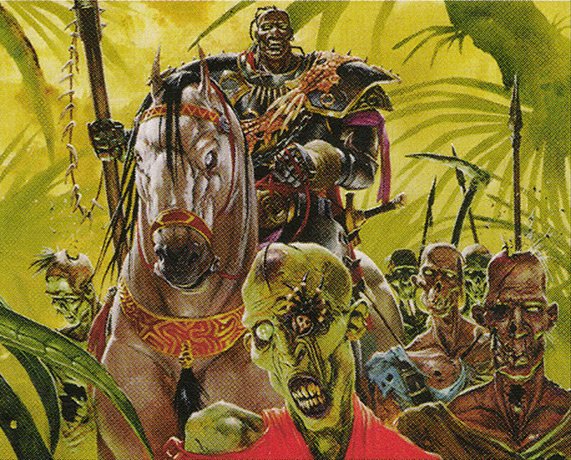
The size of Kaervek’s armies of undead, dragons, and fell spirits guaranteed that Tefemburu would not survive long, but Hakim told a tale of how the inhabitants of a city escaped a siege—a tale that came to him in a dream. The telling of the story wove a spell that caused the besieging creatures to temporarily vanish.
Knowing that the enemy would soon reappear, the guildmages decided to booby trap the city after evacuating its own citizens. As dusk fell the next day, the armies of Kaervek reappeared. Unaware of the evacuation, they charged into the city, and the trap sprang, destroying the city and Kaervek’s armies.
Kaervek was awakened from a scrying by the psychic scream of his armies’ deaths. Panicked, he summoned reinforcements with all of his remaining powers and magically searched for the being powerful enough to thwart him. He found new inhabitants on the isle that had first drawn him to Jamuraa, and he knew that they must be responsible. Kaervek gathered Jolrael and his forces and sailed to Teferi’s isle, leaving the cat warrior Purraj and a variety of minions to guard Mangara.
Kaervek’s confrontation with Teferi was short-lived, for Teferi easily sank Kaervek’s armada. During the fight, Jolrael ambushed Kaervek on his ship, severely injuring the mage. The ship was capsized, but one of Teferi’s drakes pulled Jolrael from the wreckage. Kaervek also managed to escape and limped to the nearby Uuserk marshes.
Meanwhile Asmira, Rashida,and the”Scalebane’s Elite” fought their way towards the Mwonvuli Jungle in search of Mangara. Asmira feared they would not reach him before Kaervek’s return, but hope came from above: Led by a vision, the captain Sisay and her flying galleon, The Weatherlight, landed in front of them.
With Sisay’s aid they found Mangara’s prison in under a day, and closed with its guards—Kaervek’s minions led by Purraj. Rashida saw that her troops were losing, so she fought her revulsion for her nemesis and donned a dragon mask that imbued her with superhuman strength and speed. She was able to strike down Kaervek’s forces in a dizzying attack before sinking to the ground, stunned and horrified at what she had become in order to succeed. Meanwhile, Asmira struggled with a ritual that would break the amber prison. Purraj, the only enemy survivor, leapt tor Asmira, who ignored her lethal blows and managed to complete her ritual with her dying words. Her sacrifice was punctuated by a blinding shaft of light that shattered the prison.
Freed now, Mangara magically traveled to the Uuserk Marshes to face Kaervek. A fierce battle ensued, but Kaervek at last was downed by Mangara’s Quirion archers. Before he recovered, Mangara sealed him in the same amber prison where he had suffered for so long. The war, at last, was over.
Jamuraa lives on, but the corrupting influence of Kaervek remains, and Jamuraans know they can no longer depend on the visions that saved them. The people may see the dawn of a new age, but the shadows of the past will remain to shroud their hopes.