
The Horizon Shimmers: The Making of Mirage
This content was originally included in an issue of Duelist magazine. The original articles can be accessed via Internet Archive here. The Magic website version is archived here.
Main Magazine Page: The Duelist #13
By Michael G. Ryan
The Zhalfirin soldiers are hot, despite the cooling effects of their enchanted lizardskin armor. The march across the Mtenda Plains was hard—goatherders had scattered before them as though the soldiers were tigers on the hunt, and each of them had felt the pang of regret that it had come to this. Even a herder could recognize the face paints of war.
Now the soldiers push through the Uktabi Jungle, wary of drawing attention to themselves—from the thunderous canopy dragons to the mysterious maro, the jungle is filled with predators. And as their commander, Sidar Jabari, recently said, “Kaervek’s troops are the prey that hunt us now.”
But then the dense undergrowth falls back and the Zhalfirin soldiers fall into the sun again to make their camp. Griffins wheel in the distant sky, hunting their last meal before sunset. A herd of elephants walks lazily past the encampment, bound for its secret clearing. And a lone lion, its mane matted but noble still, rests in the shade nearby, watching the soldiers clutch their charms in prayer. The beast will not look away, and this makes the soldiers nervous. They do not wish to be held in the lion’s eye—but that, of course, is where all war takes place.
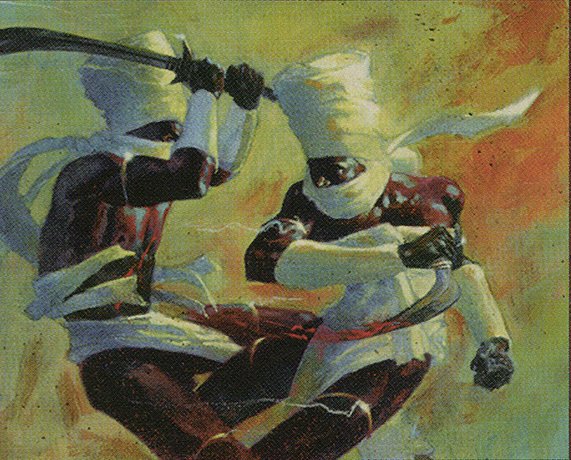
Welcome to Jamuraa, a land of dragons, golems, and legends. This is the setting for Mirage, Wizards of the Coast’s ninth expansion for Magic: The Gathering, containing more than three hundred new cards.
As the second standalone for Magic, Mirage has a tough act to follow: Ice Age, the first standalone, was a popular set, allowing for a variety of different deck-construction approaches and tournament types. To meet that same goal, Mirage offers a number of different approaches for changing the traditional Magic environment: cards that provide options, top-of-the-library effects, variations of known themes, flanking, phasing, and a stronger emphasis on creatures.
A Diversity of Creatures
“Mirage started under the name Menagerie in 1993,” says Bill Rose, who, along with Joel Mick, Charlie Catino, Don Felice, Howard Kahlenberg, and Elliott Segal, co-designed the new set. “As players, we really liked a more creature-heavy environment, so there’s a higher percentage of creatures in Mirage“—fifty percent to Ice Age’ s forty-two percent.
Some creatures in Mirage introduce the new abilities flanking and phasing, both of which add a new dimension to combat. Flanking in particular was created to get away from creatures that do little other than straightforward attacks.
“The idea comes from the military thinking of wargames, especially Napoleonic [ones],” says Rose. “If you have two massive armies, the cavalry usually tries to go around—to flank the enemy.” Phasing is a little more complicated. Rose points out that creatures’ disappearing and reappearing every other turn will be powerful in constructed-deck settings.
The Burden and Heat of the Day
Some concepts didn’t make it from the design and development stages into the final set. “We had creature classes at one point: animals, humans, dragons,” Rose says, “and cards that affected them, but that didn’t work out because it simply wasn’t compatible with Magic. We also had a lot of poison in the set. But if you do poison, it’s hard to do much of anything else. So we cut poison, which players had seen before, for flanking and phasing, both of which were new.”
Some individual cards had to be reworked as well. “Hall of Gemstone, which was originally called Second Sight,” Rose explains, “used to have very different powers. You named the top card of your library whenever you were going to draw a card. If you were right, you took another card; if you were wrong, you had to put it back. Combined with cards that let you see what’s next in your library [like Sylvan Library or Mirage‘s Preferred Selection], it became too good.”
“We tried a mass-destruction card in red—{3}{R}{R}, destroying everything: all cards in play on both sides, both players’ hands, and both graveyards,” Rose says, “but we pulled it when [Ice Age‘s] Jokulhaups came out.”
Mark Rosewater, who worked on the development of Mirage, notes that this isn’t out of the ordinary. “Actually, the most common thing that happened during the development cycle,” he says, “is that we’d get cards that were a little too powerful or in the wrong color. And we’d argue about ‘Is this really the right flavor?'”
Everything Under the Sun
A number of cards in Mirage have an effect that moves a card from one location (like a player’s hand or in play) to the top of a player’s library. Furthermore, one card in each color allows a player to search his or her library and place a particular card type on top of that player’s library. “We liked Demonic Tutor,” Rose recalls, “but realized it was too powerful. So we thought of a limiting factor—not quite getting them to your hand but instead to the top of your library, so they cost you a draw.”
Additionally, Mirage offers players a choice of how to play some of their cards: each color contains a charm, which allows a player to choose from one of three different effects when that player casts the spell.
And then there are the cards that can be played as either enchant creatures or an instants. “There’s plenty of strong stuff in Mirage for power gamers,” says Rosewater.
Weaving Lore
Pete Venters, who works in Dominia Continuity, the department responsible for the flavor and back story of Magic, acknowledges that Magic has not had much ethnic diversity in the past. Mirage provided an opportunity to correct that.
“I was walking past an African art shop and there was a painting in the window of a Nubian guard at an Arabian temple, and the dress was very different from anything I’d ever seen. It was the look of Mirage,” Venters says. “We tried to give the set an African feel through the character and card names, the look of the art, and the voices of the characters.
“We didn”t want a “tribesman” set—loincloths and the like,” he says. “We wanted a sophisticated society that reflected the magic available in the world.”
Perhaps the most significant addition of magic to the Jamuraan setting is the reflection of phasing in the Mirage story, including the long-term phasing of Teferi’s Isle, the home of one of the central characters (see “A Who’s Who Guide to Mirage.”)
“We designers tried to build a story that would explain the game mechanics,” Rose says. “And we wanted off-color magic. We wanted to get away from ‘red fights white, which fights black, which fights…” and to have colors that normally don’t work together to interact.”
Both the story and the card abilities reflect that off-color magic approach: approximately twenty cards interact with off-color casting costs and abilities, and the primary characters in the story move along different lines of alliance than “color.”
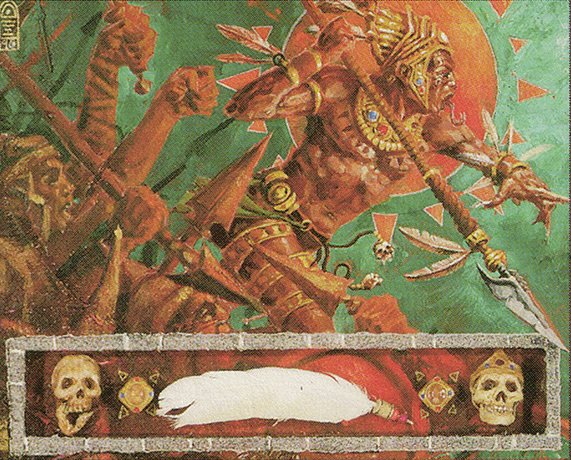
“At about the same time as the designers were working on that,” Venters continues, “a thread appeared on the Internet about flavor text. It pointed out that a lot of flavor text just didn’t have any meaning outside its set—it was tied too closely into the stories. So we tried to build a theme set that simply built the world, gave you hints about it, and let you build the rest yourself… very much like the basic set.”
All in all, nearly forty characters speak in the Mirage flavor text, some of them only once, some of them many times. From merchants to soldiers to herders, each character adds perspective to the continent of Jamuraa and the three nations that struggle for harmony within.
The Lions’ Pride
Unlike parents who draw no distinction between their children, the designers, developers, and artists of Mirage admit to having favorite cards in the set—though sometimes for quite different reasons. Which cards are their favorites? “Polymorph,” Rose says with certainty. “It’s such an uncertain card [a sorcery that buries a creature, then allows that creature’s controller to replace that creature with the next one in his or her library]. You never know what you’re going to get.”
And Rose clearly has a preference for cards with unpredictable outcomes. Illicit Auction ranks as another of his favorites. It forces players to bid life for a target creature; the player who bids the most life loses that life but gains the creature. “People will have to learn how to play this card,” Rose notes.
Dragons, which are highly prevalent in the set, pull a lot of weight with both Rose and Rosewater. Rose cites Volcanic Dragon, a 4/4 flying creature that is unaffected by summoning sickness, as a potentially superior card to Shivan Dragon. And Rosewater points out the nearly unkillable Mist Dragon. “I really wanted a creature that could phase itself,” he says, “and that’s what the Mist Dragon does. You can give it flying; you can take flying away from it; you can make it phase out. It’s like a Blinking Spirit that doesn’t return to your hand. Your opponent can’t get rid of it without killing it multiple times.”
“And don’t forget Final Fortune,” Rose adds. “Players want Time Walk? Well, here it is… sort of.”
The Cardboard Jungle
Both Type I and Type II tournaments should see changes with the arrival of Mirage; with this new standalone replacing Ice Age as the fair-weather friend to Type II and with Fifth Edition just around the bend, players will need to be on the lookout for new and challenging combos.
“The changes between Fourth Edition and Fifth Edition will make a big difference [to Type II play],” Rose says. “Mirage won’t be able to fill all of the gaps, but it should do a pretty good job.”
And what about Type I? “As someone said the other day,” Rose notes, “Type I is the ability to find all the broken cards in Magic and put them together. So I imagine we’ll have a few Type I cards.”
But exactly which cards?
Both Rose and Rosewater just grin.
Best known for his Magic short stories, Michael G. Ryan is a freelance writer and an editor for Wizards of the Coast.
The Mox that Almost Was
By Michael G. Ryan
If ever there was ever a word in Magic that could inspire collecting fever, that word is “Mox.” And players were nearly treated to a sixth Mox in Mirage—if only for the reaction that word causes.
The Mox Crystal. For 0 casting cost, it provided you with one colorless mana any time you tapped it; however, if any other player played another Mox Crystal, yours would be buried. Unfortunately, Moxes are not really favorites of the developers in Wizards of the Coast’s Research and Development. “The Mox Crystal wasn’t well-received,” Bill Rose, co-designer of Mirage, admits. “So we yanked it from the set.”
So what took its place on the rare sheet? The Lion’s Eye Diamond, a 0 casting cost artifact that, when sacrificed, provides you with three mana of any one color. Sound familiar?
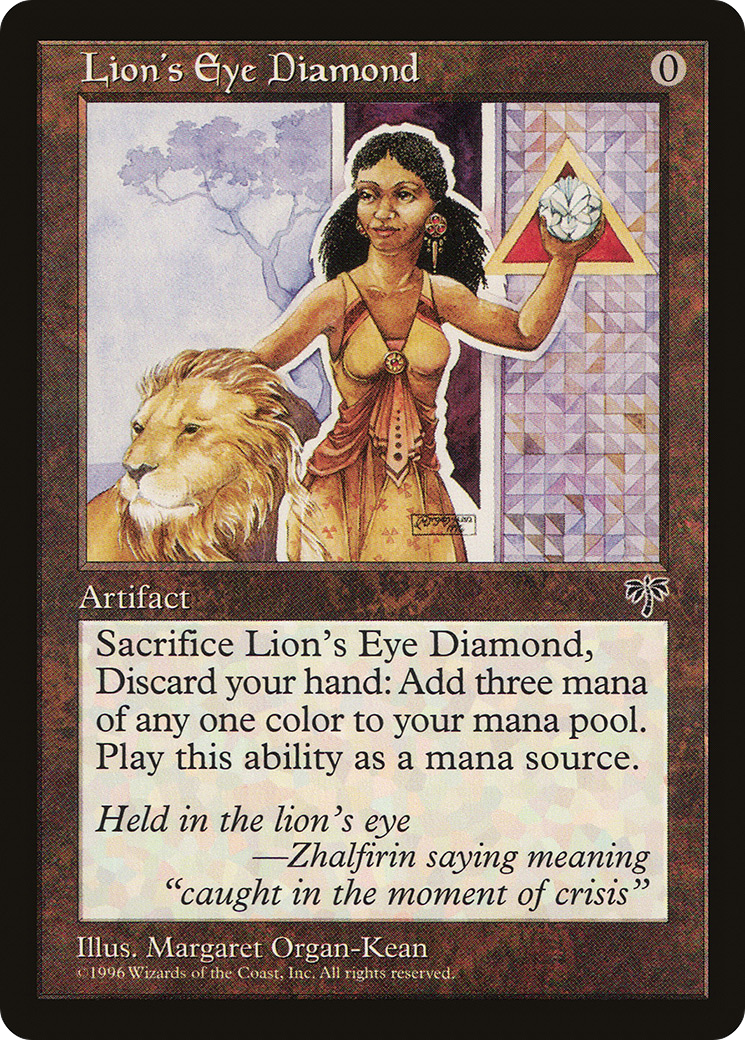
“It’s a Black Lotus… with a catch,” Rose says.
—M. G. R.
The Names of the Game
Some cards in Mirage are loaded with trivia. Using the card list on pp. 64-65, can you guess which cards are described below?
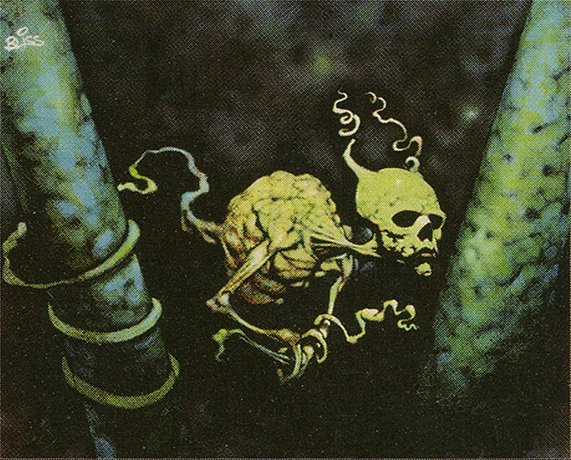
- This card, first designed for Mirage, used to be a 0 casting-cost counterspell that only required the caster to have an island in play to use it.
- This black card was originally called “Damien’s Cry,” after co-designer Bill Rose’s howling cat.
- This character’s name (which appears as part of multiple card names) is an “anagram.”
- This card’s name is the original name for Ancestral Recall.
- One of the designer’s of Mirage was dubbed “Mr. Toilet.” Which card is a take-off on this name?
BONUS QUESTION: The character Jolrael (named on Jolrael’s Centaur) actually appears on this enchant-creature card from Legends and Fourth Edition.
ANSWERS:
1. Memory Lapse; 2. Soulshriek; 3. Mangara; 4. Ancestral Memories; 5. Telim’Tor BONUS: Spirit Link
Seeing Through Mirage
Not since Arabian Nights has a Magic expansion created such an identifiable world as Mirage does. Extraordinary and exotic animals, creatures, and people, combined with bold design and splashes of earthy colors make the world of Jamuraa no mere mirage . Obviously, the artists took great pains to make Mirage unique, to make it reflect the world that it depicts. But someone else needs to get credit for this vision, and that someone is 38-year-old Sue Ann Harkey.
Former art director for EVERWAY and a veteran of the publishing field, Harkey took over as art director for Magic: The Gathering in December, 1995. Mirage is the first Magic expansion she directed. “I was doing a lot of experimentation with Mirage,” she explains. “I was trying out new artists, so in some respects it was a bit of a grab bag. But overall I”m pleased.”
Getting workable art for a Magic expansion is a complex process. First, Research and Development writes an art description based on the card name and mechanics; then it goes through Dominia Continuity to get the right flavor. That’s when Harkey gets the description and couples the right artist with the right piece. “That can be the most difficult part,” says Harkey, “but I think I was successful… I gave Final Fortune to D. Alexander Gregory because it was a gory piece, and he hates doing gory pieces. So I knew he’d make it look beautiful.”
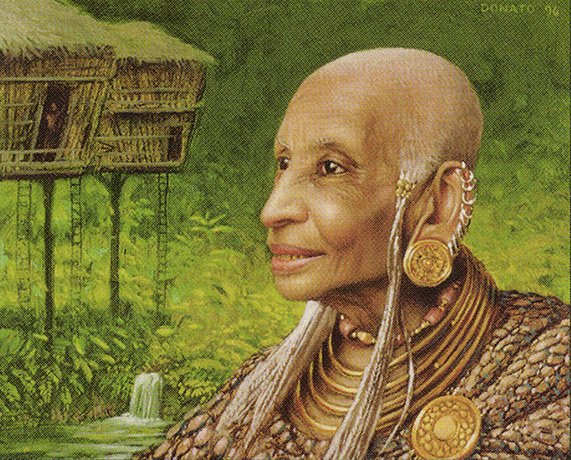
Once the art is assigned, the artists submit sketches for approval by different departments, with Harkey having final approval. Sometimes the paintings are unusable, and sometimes they require a bit of juggling so that art better fits the card. For example, Vigilant Martyr originally portrayed a female, but in some foreign languages a female martyr translates to a different word and so the summon line would need to be changed on some foreign-language cards. To avoid this, Vigilant Martyr’s art was given to Healing Salve, Elixir of Vitality got the Salve’s art, and Vigilant Martyr ended up with the art originally assigned to the Elixir.
Harkey looks forward to future expansions, and though she thinks Mirage was a success, she feels she will do better in the future. Is she a perfectionist? Perhaps, but one thing is certain: her dedication and love for her job means we can look forward to more astounding artwork for Magic.
—Melody Alder